ATTENTION: TOOL OWNERS, DIYers & WORKSHOP HOBBYISTS
The $3 Kitchen Ingredient That Exposed a Dirty Little Secret the Tool Industry Doesn’t Want You to Know
How one frustrated woodworker discovered that the rusty tools everyone throws away are hiding hundreds of dollars in value — and the fix takes nothing more than vinegar, salt, and a free afternoon.
Last year, a man bought a rusty hand plane at a garage sale for $4.
It looked like garbage. Thick orange crust. The knob wouldn’t turn. His wife told him to throw it away.
Instead, he soaked it in white vinegar overnight. Scrubbed it the next morning. Sharpened the blade on a $20 whetstone.
That “garbage” plane now shaves wood smoother than a $160 brand-new model sitting on the shelf at the hardware store.
His total cost? $4 for the plane, $3 for the vinegar, and about 90 minutes of his Saturday.
▼
That story isn’t unusual. It happens every weekend, at every flea market and estate sale in the country.
Rusty tools get tossed into the “free” pile. They get thrown in dumpsters. They get left to rot in damp sheds because people assume rust means the tool is finished.
They’re wrong.
And the tool industry is perfectly happy to let you keep believing that, because every tool you throw away is a tool they get to sell you again. At full price.
Here’s what they don’t tell you:
Rust is almost always just a surface condition. Underneath that ugly orange crust, the steel is perfectly fine. The forging is intact. The tool works. It just needs someone who knows how to clean it.
And the cleaning methods? They’re absurdly simple. White vinegar. Baking soda. Citric acid from the grocery store. A wire brush. That’s it.
No specialty chemicals. No expensive equipment. No professional training.
Just a handful of household ingredients and the knowledge of how to use them correctly.
The Problem Is, Most People Get It Wrong
They soak a tool for too long and the vinegar eats into the metal. They forget to neutralize the acid and the tool flash-rusts overnight. They scrub with the wrong abrasive and scratch a precision surface. They skip the protection step and end up right back where they started.
Or they try a random tip they saw online, get mediocre results, and conclude that rust removal “doesn’t really work.”
It works. It works beautifully. But only if you know exactly what to do, in exactly the right order, for exactly the right amount of time.
That’s the difference between a YouTube hack and a complete system.
That system is what you’re about to get.
INTRODUCING
The Rust Restoration Handbook
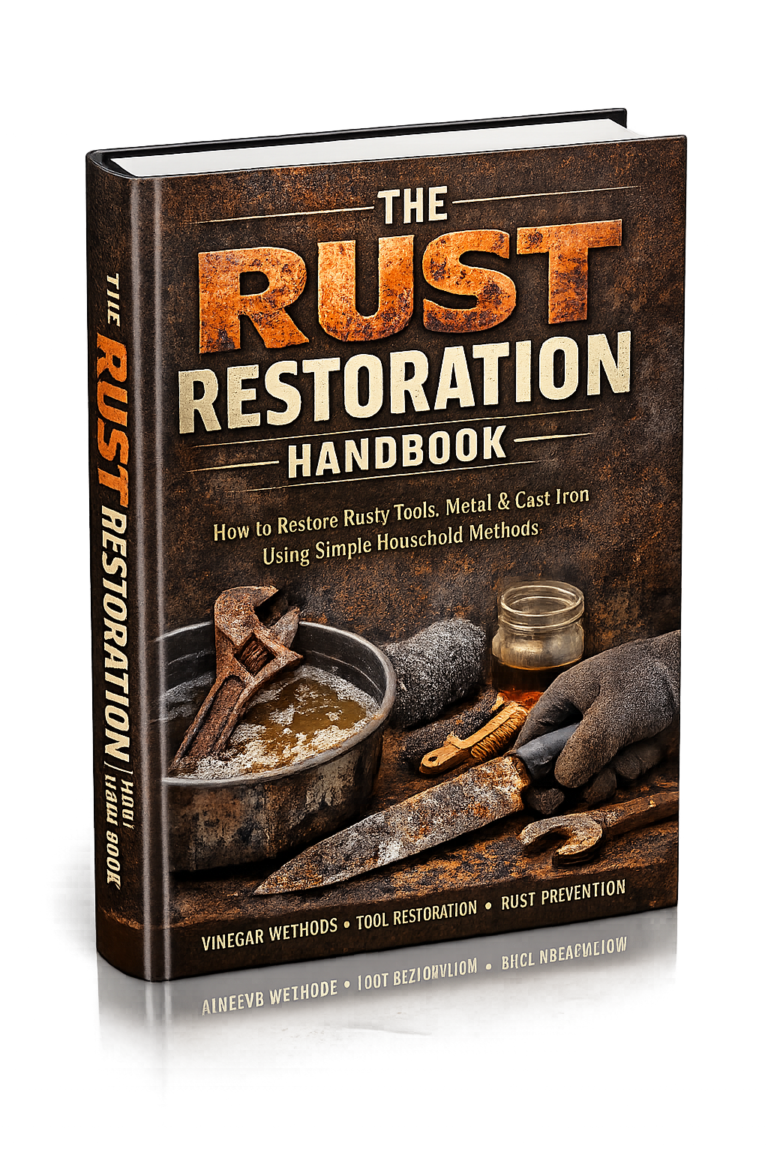
How to Restore Rusty Tools, Metal & Cast Iron Using Simple Household Methods
This is a 101-page, 12-chapter workshop manual that gives you the complete system for removing rust and restoring tools to near-new condition — using ingredients that cost pennies per use.
It’s written the way a master craftsman teaches an apprentice: clear steps, practical explanations, no fluff. You don’t need a chemistry degree. You don’t need a workshop full of equipment. You need a plastic tub, a gallon of vinegar, and this book.
Inside, you’ll find four proven rust removal methods, each presented as a complete procedure with material lists, timing charts, and troubleshooting guides. You’ll know exactly which method to reach for — whether you’re cleaning a set of socket wrenches or saving a hundred-year-old hand plane.
Here’s a Fraction of What You’ll Discover Inside:
✔️ The classic vinegar soak method — the six-step process that handles 80% of all rust removal jobs. Costs less than a cup of coffee. (Chapter 3)
✔️ Why salt changes everything — add this one pantry ingredient and you cut your soak time in half. Plus: the paste method that works on items too big to submerge. (Chapter 4)
✔️ The citric acid advantage — faster than vinegar, almost zero odor, and the #1 choice for cast iron restoration. Exact dilution ratios included. (Chapter 5)
✔️ How to build a $20 electrolysis rig that removes rust without removing a single atom of metal — the secret weapon for antique tools and anything with maker’s marks worth preserving. (Chapter 6)
✔️ Complete hand tool restoration — dedicated guides for chisels, hand planes, screwdrivers, and saw blades. Disassembly, rust removal, sharpening, and reassembly. (Chapter 7)
✔️ Garden tool rescue — shovels, rakes, shears, and mower blades. The aggressive methods these tools need, plus a 30-second post-use habit that prevents rust permanently. (Chapter 8)
✔️ Cast iron cookware brought back from the dead — strip, de-rust, and reseason a skillet to glossy, non-stick perfection. The complete process, including the “upside-down oven” technique. (Chapter 9)
✔️ Professional polishing and finishing — steel wool grades, buffing compounds, and the three finish levels. Know when to stop: functional, satin, or mirror. (Chapter 10)
✔️ The permanent rust prevention system — oils, waxes, humidity control, VCI products, and storage methods that keep your tools rust-free for years. (Chapter 11)
✔️ How to save tools everyone else would throw away — the assessment framework for extreme rust, the six-step combination approach, and how to know when a tool is truly beyond saving. (Chapter 12)
✔️ BONUS: Printable Quick-Reference Guide — a workshop wall chart with all four methods, soak times, safety reminders, and protection products at a glance.
✔️ BONUS: Tool Restoration Checklist — a step-by-step checkbox sheet you photocopy and use for every project. Assessment, prep, removal, finishing, and protection.
Let’s Do the Math on What This Saves You
A new bench chisel set: $45–$120.
A rusty set from a flea market, restored with this book: $8 total.
A new hand plane: $60–$300.
A vintage Stanley from an estate sale, restored: $9 total.
A new cast iron skillet (artisan quality): $150–$300.
A Lodge rescued from a barn, stripped and reseasoned: $3 total.
A single garden tool set (shovel, rake, shears): $80–$150.
A full set pulled from the “free” pile, restored: $5 total.
Restore just two or three tools and this book has paid for itself dozens of times over.
The tools are better than new. The steel is often higher quality. The construction is often more solid. And the price is a fraction of what you’d pay at the hardware store.
This Is for You If…
✔️ You own tools that are sitting in a drawer rusting right now
✔️ You’re tired of replacing tools that could be fixed for pennies
✔️ You hunt for deals at flea markets, estate sales, or garage sales
✔️ You have a cast iron skillet that’s seen better days
✔️ You believe in restoring rather than replacing
✔️ You’d rather spend a Saturday in your workshop than at Home Depot
✔️ You want to know the correct way — not a random internet hack that might damage your tools
Whether you’re a woodworker, a mechanic, a gardener, an antique collector, or just someone who hates wasting money — this book was written for you.
So What Does a Book Like This Cost?
The Rust Restoration Handbook is a 101-page, 28,000-word professional manual with 12 chapters, 4 complete rust removal systems, tool-specific restoration guides, and printable workshop references.
The regular price is $97 — and at that price, it pays for itself the first time you restore a single tool instead of replacing it.
But right now, for a limited time, you’re not going to pay $97.
You’re not going to pay $47.
You’re not even going to pay $27.
LIMITED TIME INTRODUCTORY PRICE
$97
$7
That’s 93% off — less than a gallon of vinegar.
Instant PDF download • Yours to keep forever
⚡ Instant download • PDF format • Read on any device • Keep forever
Try It Risk-Free: The “Restore One Tool” Guarantee
Download the book. Pick the rustiest tool you own. Follow the steps for any one of the four methods.
If that tool does not come out cleaner, sharper, and better than you expected — or if you feel the book was not worth every penny of your $7 — simply contact us and we’ll refund you in full.
No questions. No hassle. No time limit on the guarantee.
You risk nothing. The rusty tools in your shop, however, have everything to lose.
You Have Two Choices Right Now
Option one: Close this page. Keep throwing away rusty tools. Keep paying full retail for replacements that are often built worse than the originals. Keep wondering if there’s a better way.
Option two: Spend $7 — less than a fast food lunch — and learn a skill that will save you hundreds of dollars a year for the rest of your life. A skill that turns $5 flea market finds into tools that outperform $60 store-bought versions. A skill that transforms your workshop, your garden shed, and your kitchen.
The choice is yours. But this price won’t last.
🔒 Secure checkout • Instant PDF download • Risk-free guarantee
P.S. — Remember: this price is temporary. When this introductory offer ends, the Handbook goes back to $97. At $7, you’re paying less than a single gallon of the vinegar you’ll use in Chapter 3 — and that chapter alone will save you more than the price of the book on your very first restoration project.
P.P.S. — Think about the tools you already own that are rusting right now. In your garage. In your garden shed. In that box in the basement. Every one of them is a restoration project waiting to happen. Every one of them is money you’ve already spent, sitting idle because of a surface condition that costs $3 to fix. Get the book and fix them this weekend.
© 2026 Joe Paradza • The Rust Restoration Handbook • All rights reserved